

Chronotypes Explained for Writers: Find Your Creative Window
When do you write best: morning, afternoon, or late at night? Stop forcing, start flowing.

When does your creativity actually peak?
For many authors, the answer has little to do with discipline or motivation and much more to do with biology.
In a recent discussion with the LegendFiction writing community, founder Dominic De Souza introduced an idea unfamiliar to many writers: the concept of the chronotype, a person’s natural rhythm for sleep and wakefulness.
“Your chronotype is your sleep pattern,” De Souza said while presenting the concept during a community walkthrough. “And if you’ve never heard of that, which most of us never have, it’s extremely helpful to know about.”
The idea comes from sleep research and describes the internal clock that determines when people feel alert, tired, or mentally sharp during the day.
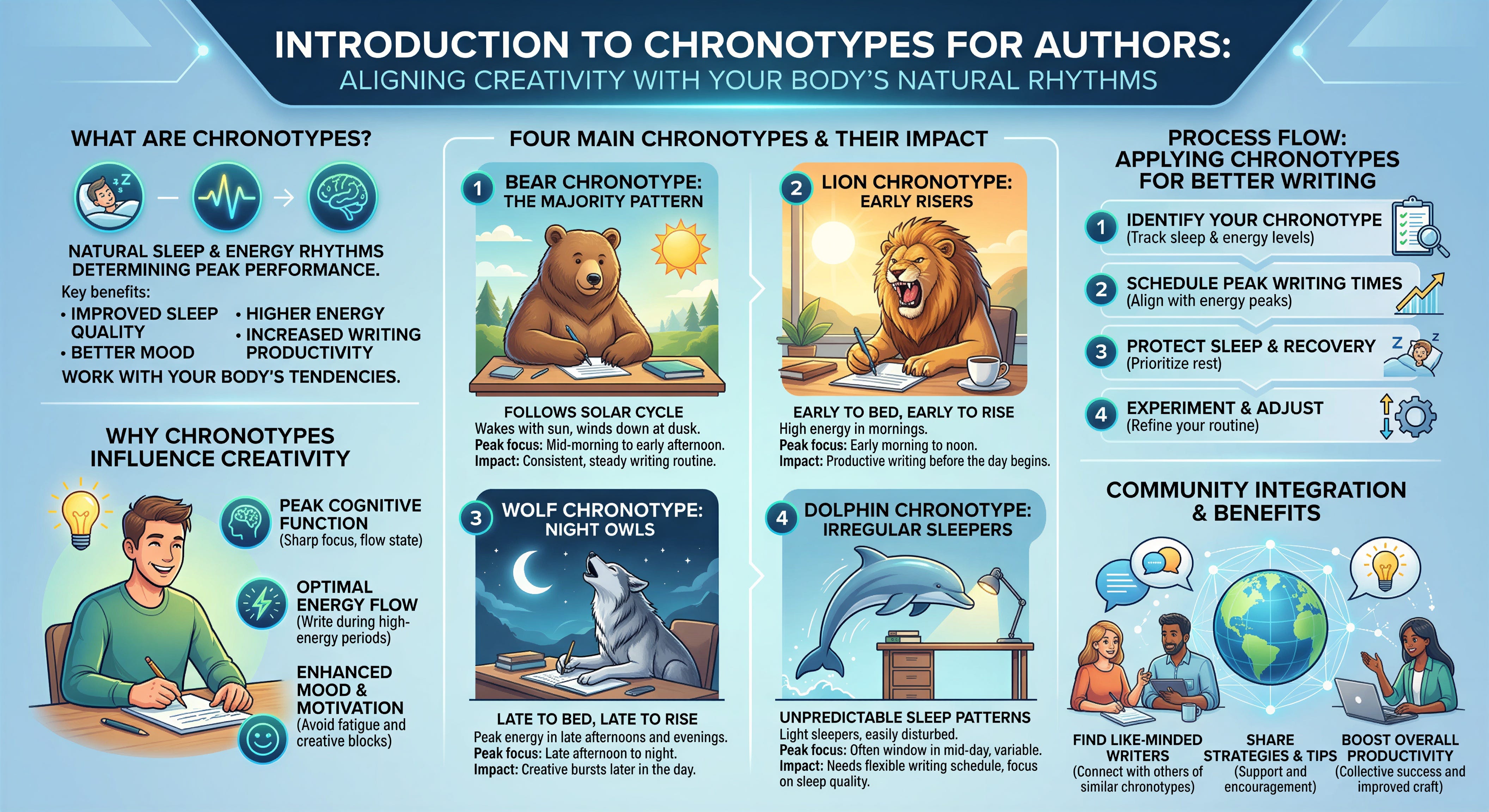
For writers — whose work relies on sustained mental focus and imagination — understanding that rhythm may change when and how they write.
Content courtesy from UCLA Health | Sleep Foundation
The Hidden Clock Behind Creative Energy
Chronotypes describe the body’s natural preference for sleep and wakefulness, a rhythm influenced by genetics and the circadian cycle that governs the body’s daily functions.
Researchers studying sleep patterns have found that these rhythms shape more than bedtime. They influence energy levels, mood, productivity and cognitive performance.
“Chronotypes are natural preferences of the body for wakefulness and sleep,” De Souza explained while walking through research compiled from sleep studies. “An individual’s chronotype is influenced by genetics and it’s driven by your circadian rhythm.”
In practice, this means some people feel sharp at sunrise, others in the afternoon, and others long after midnight.
For writers who struggle to produce work after a long day, the discovery can feel validating.
“You kind of want to be writing at the time of day when you have the most energy,” De Souza said. “If you can swing it, put the things that matter most to you at the time of day when you have the most energy.”
The Four Chronotypes: Lion, Bear, Wolf and Dolphin
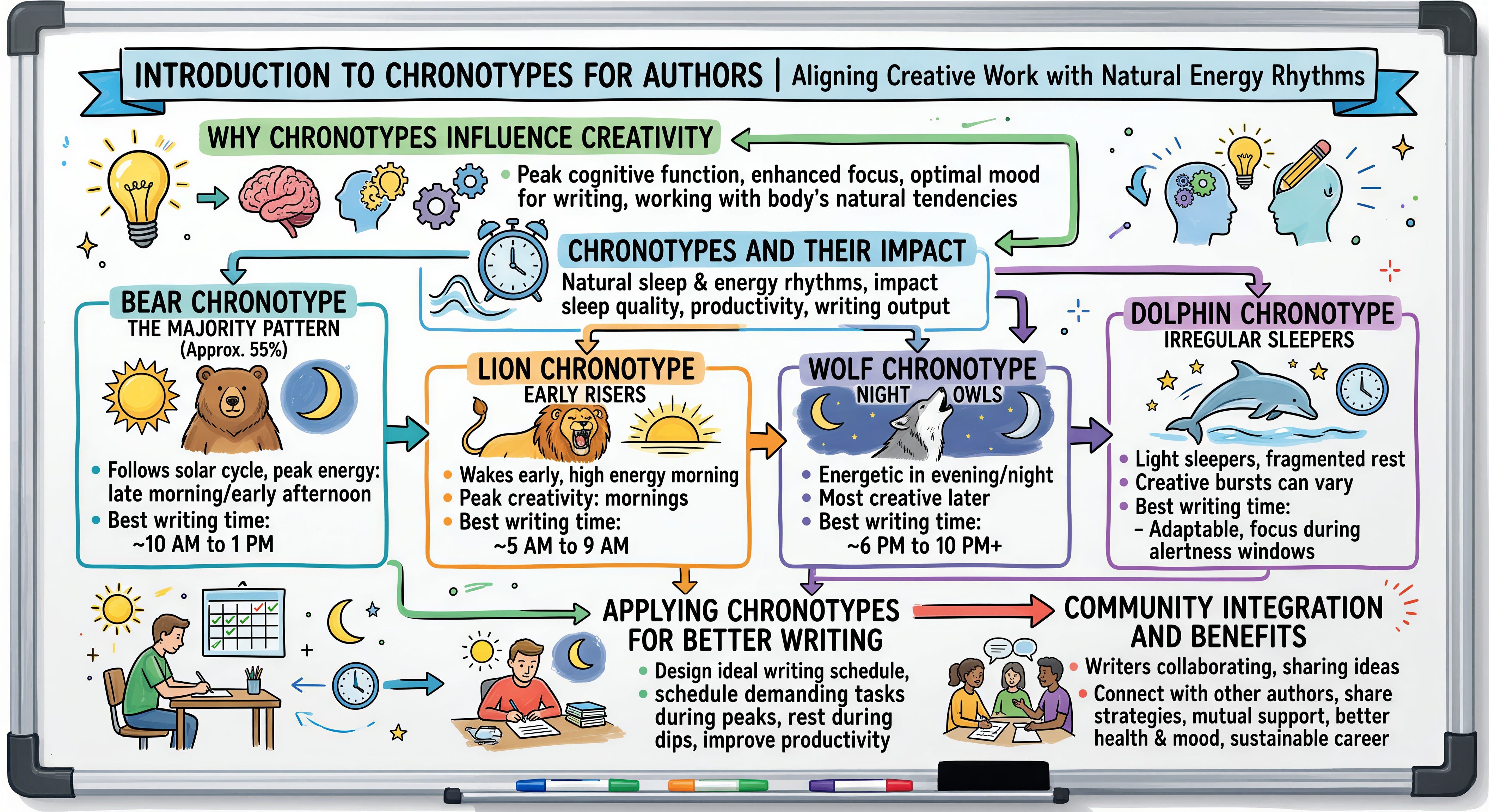
Sleep researchers often group chronotypes into four animal-based patterns popularized by sleep specialist Dr. Michael Breus.
The categories translate sleep rhythms into recognizable behavioral patterns.
The Bear
Bears represent the majority of people.
“Bear chronotypes make up about 55 percent of the population,” De Souza explained.
People in this group tend to follow the sun. They wake and sleep at conventional times and generally perform well within traditional work schedules.
“They do well with traditional office hours,” he said, “but they have no problem maintaining a social life in the evenings.”
For many writers balancing work, family and creative projects, this pattern offers flexibility — writing can happen in the morning, afternoon or early evening depending on the day.
The Wolf
The wolf represents the classic night owl.
Wolves often feel mentally alive long after sunset and struggle with early mornings.
“The wolf chronotype is equivalent to the classic night owl,” De Souza said, noting the group is believed to represent roughly 15 percent of the population.
These writers may produce their most imaginative work late at night, when the world grows quieter and distractions disappear.
For decades, famous authors have described this pattern — working through the night and sleeping well into the morning.
The Lion
Lions occupy the opposite end of the spectrum.
They wake early, often before sunrise, and produce their strongest work in the morning hours.
“The lion chronotype stands in for the early bird,” De Souza explained.
Morning productivity can come with tradeoffs. Many lions find their energy fading quickly at night.
“They wake up early and they’re most productive in the morning,” he said. “But they may have more trouble following a social schedule in the evenings.”
For writers in this category, dawn writing sessions may produce their best work.
The Dolphin
The dolphin chronotype describes people who experience inconsistent or disrupted sleep.
The name comes from an unusual biological trait in real dolphins: the ability to rest half their brain at a time.
“The fascinating reason dolphins are actually in this is because dolphins do something weird,” De Souza said. “They can shut down half of their brain and put it to sleep and the other half stays up.”
Human “dolphins” tend to have lighter sleep and irregular schedules, often resembling chronic insomnia.
“Nobody else does this,” he added with a laugh. “The rest of us just crash and that’s it.”
Why Writers Often Ignore Their Natural Rhythm
Despite how strongly chronotypes shape energy patterns, many people work against their internal clock.
Job schedules, family obligations and cultural expectations frequently dictate sleep habits instead.
“We often fight these natural inclinations due to work obligations or family schedules,” De Souza said. “Or fear of missing out on stuff.”
For writers, this can mean trying to produce creative work when the brain is already exhausted.
“Most people are simply trying to cram their creative life into an already crammed existence,” he said.
The result can feel like a lack of discipline or motivation, when the real issue is timing.
Finding the “Magical” Window for Creativity
Writers who align their work with their chronotype may discover a surprising shift in productivity.
De Souza described these peak periods as moments when the brain has easier access to creativity.
“How can we truly enjoy our creativity,” he asked, “if we’re not accessing the magical time of day when we have access to our deepest creative selves?”
The solution may begin with simple observation.
Pay attention to when focus feels strongest. Track when ideas flow easily. Notice when fatigue shuts down creative thinking.
From there, writing sessions can move toward those high-energy hours.
“Knowing your chronotype can give you more confidence about yourself,” De Souza said. “You’re working with yourself instead of against yourself.”
Turning Sleep Science Into a Writing Strategy
Within the LegendFiction community, the chronotype lesson appears as part of a broader guide for writers building sustainable creative habits.
Members explore the four types and identify their own patterns before adapting their writing schedule.
The exercise also includes small behavioral adjustments, such as aligning exercise, sleep, and writing with peak energy periods.
“If you’re a night owl who needs to wake early,” De Souza explained, “optimize light exposure in the morning and limit it at night.”
Consistency also plays a role.
“Go to bed the minute you feel tired,” he said, encouraging writers to avoid fighting natural sleep cycles.
A Simple Idea That Can Change a Creative Routine
The concept remains surprisingly unfamiliar to many writers.
“Most authors that I’ve met have never heard of chronotypes,” De Souza said.
Yet the discovery often reframes how writers think about discipline and productivity.
Instead of forcing creativity into an inconvenient hour, the goal becomes simpler: find the moment when the mind naturally wants to create.
“You will be happier because you’re working with your system,” De Souza said.
“And you’re working with how you want to function — instead of how you’re being forced to.”
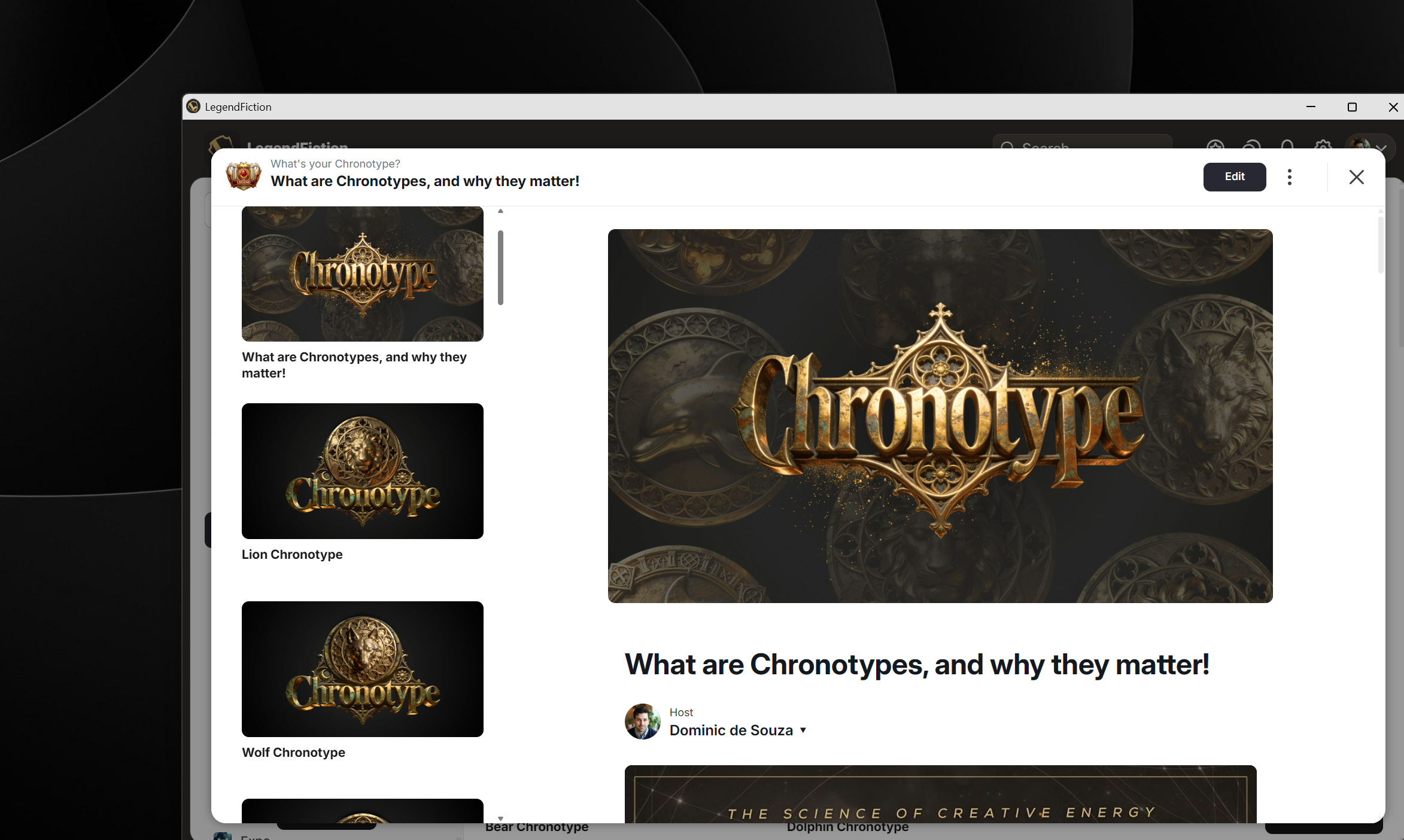
All this and more is neatly gathered as a mini-course for members.
*cough... written like it's a professional press release... because why not. :)
100% wolf, which makes me happy because that's my favorite animal <3